

The Last Cow
Sarah Thankam Mathews’ dystopian fiction piece on longing for something you’ve never had.
Cake friends,
Hope you’re staying cool. We’re very excited to be partnering again with our friends at One Love Community Fridge for a special day of baking and food distribution in Bed Stuy on Sunday, May 31st. Bakers of all levels are invited to bring one large completed baked good to share in OLCF’s network of community fridges across NYC alongside other grocery donations. Last year, we contributed over 1K pastry boxes to community fridges.
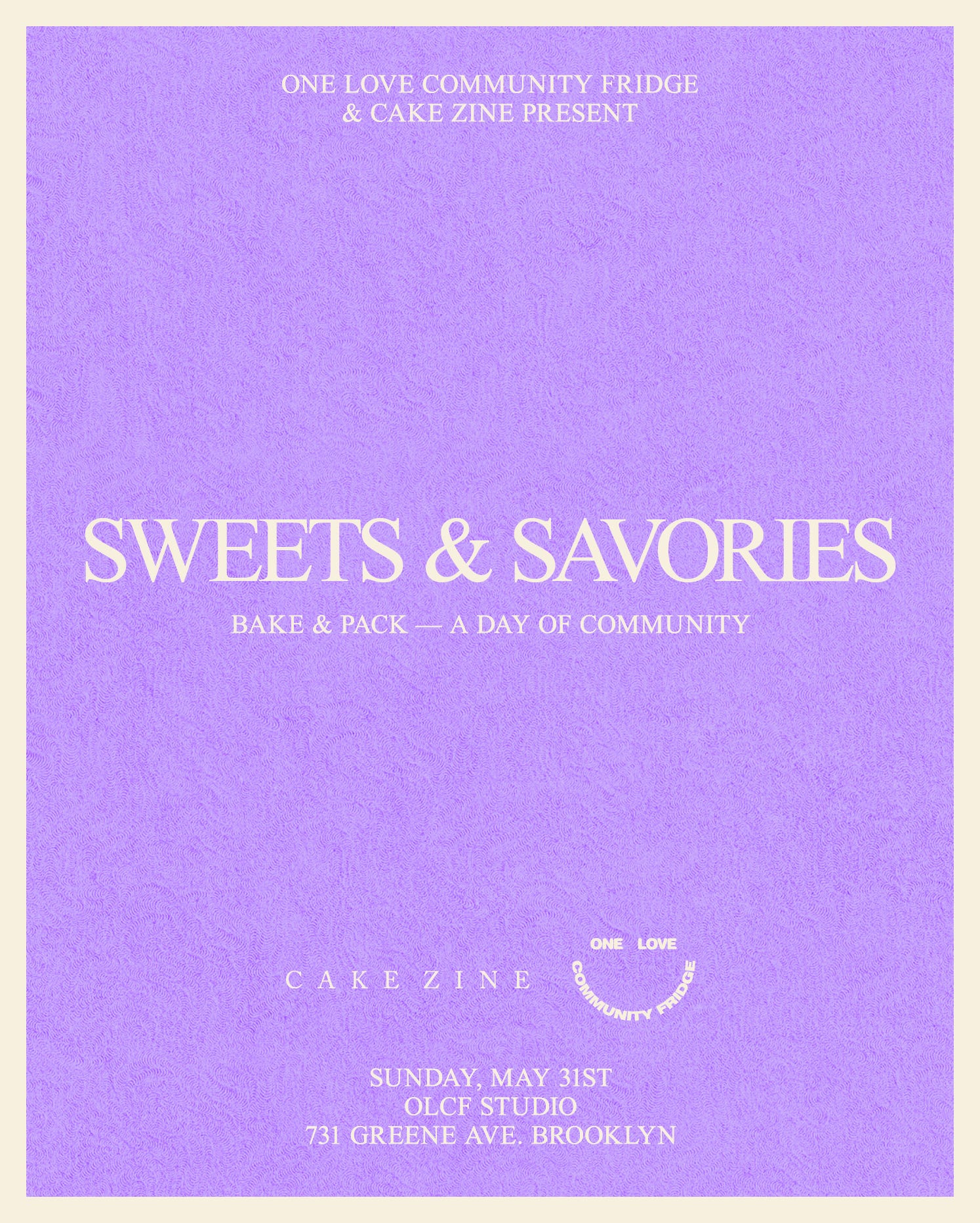
We’ll have coffee provided by Bótani Café and flavored sparkling water by Pure X-Tract to help fuel the packing and snacking. Sign-ups are now live for two time slots, with just a few spaces left for the morning session; register here.
Today in the newsletter, we’re sharing a piece of short fiction excerpted from Steak Zine. The Last Cow by Sarah Thankam Mathews follows a young chef racing to visit her estranged grandmother before international ports close in a climate-ravaged future. As synthetic steak replaces real livestock and borders harden overnight, the piece explores migration, inherited grief, and nostalgia for a world that no longer exists. It’s a strange and enthralling read, and one of our favorite pieces in the issue.
The Last Cow
Fiction by Sarah Thankam Mathews
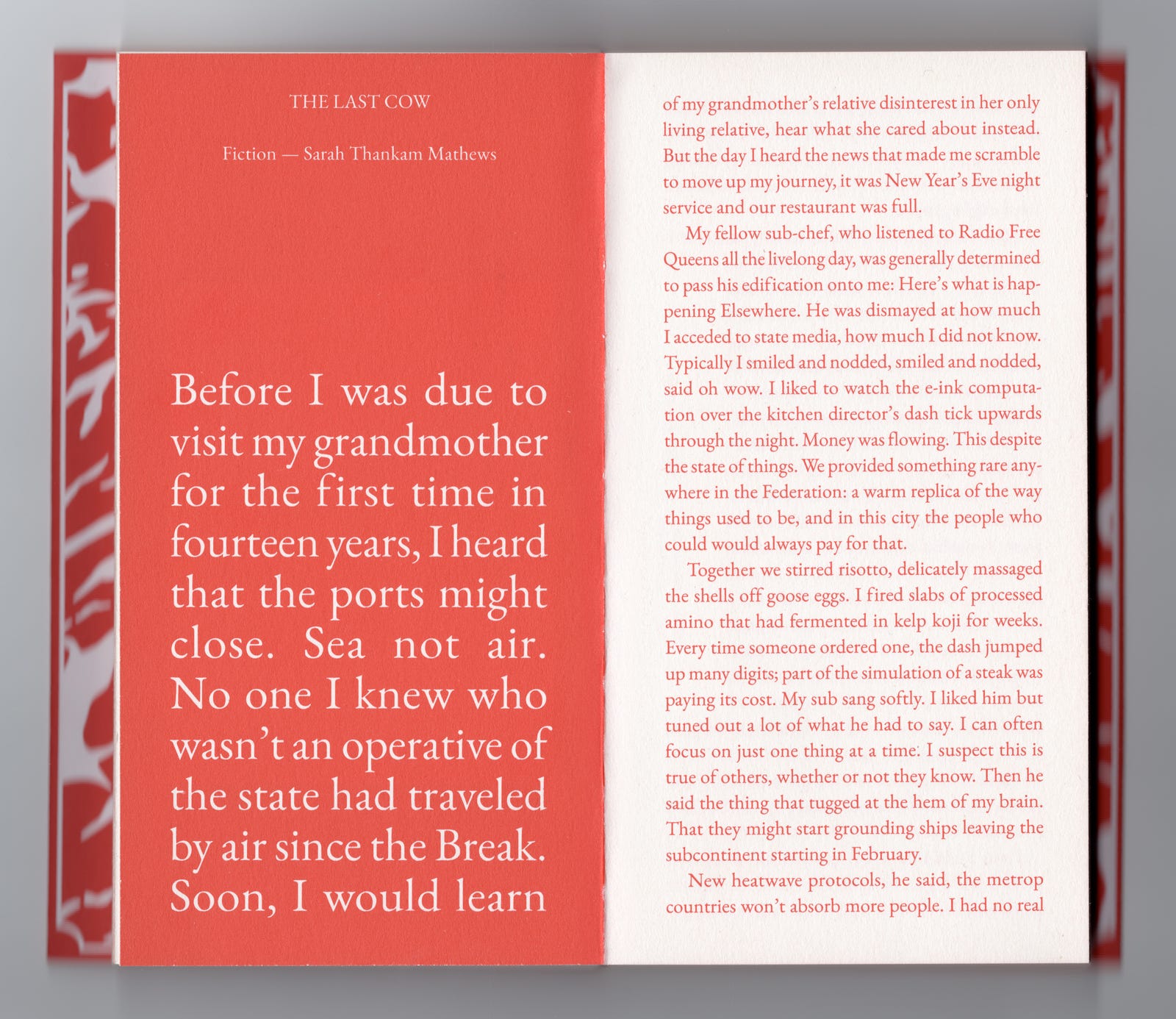
Before I was due to visit my grandmother for the first time in fourteen years, I heard that the ports might close. Sea not air. No one I knew who wasn’t an operative of the state had traveled by air since the Break. Soon, I would learn of my grandmother’s relative disinterest in her only living relative, hear what she cared about instead. But the day I heard the news that made me scramble to move up my journey, it was New Year’s Eve night service and our restaurant was full.
My fellow sub-chef, who listened to Radio Free Queens all the livelong day, was generally determined to pass his edification onto me: Here’s what is happening Elsewhere. He was dismayed at how much I acceded to state media, how much I did not know. Typically I smiled and nodded, smiled and nodded, said oh wow. I liked to watch the e-ink computation over the kitchen director’s dash tick upwards through the night. Money was flowing. This despite the state of things. We provided something rare anywhere in the Federation: a warm replica of the way things used to be, and in this city the people who could would always pay for that.
Together we stirred risotto, delicately massaged the shells off goose eggs. I fired slabs of processed amino that had fermented in kelp koji for weeks. Every time someone ordered one, the dash jumped up many digits; part of the simulation of a steak was paying its cost. My sub sang softly. I liked him but tuned out a lot of what he had to say. I can often focus on just one thing at a time. I suspect this is true of others, whether or not they know. Then he said the thing that tugged at the hem of my brain. That they might start grounding ships leaving the subcontinent starting in February.
New heatwave protocols, he said, the metrop countries won’t absorb more people. I had no real clue what he was talking about, but I listened, suddenly transfixed by the pertinent fact of my ship ticket, which had me leaving mid-January, arriving on the twenty-seventh. Three days before outbound ships might ground.
“But I’d be going in,” I said, trailing, uncertain, over-firing the amino. He clapped me on the shoulder, shook his head. “Hey dumbfuck, would you not maybe want to come out?” He talked about the ghost voyagers from the Break years, stranded ships of thousands, no place to go. I tuned him out, feeling the prickle of personal history. My father had flown in the year immediately pre-Break. Air not sea. Paying a princely sum twelve years ago to see his mother in Kerala—the mother who had left him yet again, as she had throughout his life. After returning from this voyage, he lay around for weeks, seeming so ill at heart that it filled me with fear. I brought him cups of juice, climbed up on the bed and rubbed his back. He played dead under the quilt, but I knew the gesture meant something to him. How could it not, someone small you once took complete care of, taking care of you.
“Your Grandma Sarah is a piece of work,” my mother had said through gritted teeth, but not around my father.
I was a child then. My parents still alive. The Break’s half-decade-long merciless cascade had not yet reformulated the fundamental order of things.
Now I was twenty-three, made enough money to travel, and, two years after losing my immediate family, did really quite want to see my piece-of-work grandmother. The words echoed in my head as we shut the restaurant down: Ports could close. I checked my wrist. I would go dancing, then stop at the baths, then sleep. In the interstices of all this, I would devise a plan.
I glanced over my shoulder as I stepped out. The dash noted the night’s totals, soon to be distributed among us. The highest numbers by far were for “champagne” and “steak.” Who in that restaurant had held a bunch of grapes in their lifetime? I had not seen a cow outside of a picture book since I was a young child and even then it was from a great distance: a speck on a far field. Husbanded livestock of all kinds, soil-based ag—these had dwindled even pre-Break.
As the powder-pink of dawn coated the city’s skyline, as the wintry wind began to freeze my wet hair, I recorded a message into my wrist. Grandm—sorry, Sarah Ammachy. Some things have changed, it seems. I have to come early, so I can leave okay. Okay? As was often the case, I felt embarrassment for having no Malayalam, then remembered that she spoke perfect English, had come here young, had lived here for decades before remigrating, before leaving us behind.
*
I was already on the ship when, a full week later, she replied to say, I thought about it more and I don’t know if you should come. It’s not very convenient for me. Things are difficult here.
I am already on my way, I offered, cheerily. I won’t add to your responsibilities.
For days she did not respond. I walked on the ship’s vast iron deck, ate chestnut bread and amino. The ship’s administrators had told us not to worry. If Kerala shut its ports, we would divert south. “Redundancies are in place,” they said often.
I’d taken ships before, but only for little hops between the islands off the former U.S. coast. Routes, pampered by calm water and tight patrol corridors, that all ended before there was time to miss land. Nothing like this long, exposed crossing. I’d known exhilaration when I first took the plunge and bought my ticket. Once I adjusted my date, I realized I was headed somewhere I’d never gone and had little sense of what this journey would be.
Cold, strange, exciting, punctuated by spells of nausea, seemed to be the answer. The waves were a story high some days, gentle others. We had to zigzag far out of our route, again and again, to stay clear of storms and pirate drone swarms. I had a flirtation with one of the barkeeps, but my heart was not in it. I missed the baths, missed seeing everyone. The morning after the barkeep left my pod, my grandmother, never one for linear conversation, asked if I still worked in the schools, and I said no, no, a high-end restaurant.
She wrote back only: !
Impulsively, that evening, I showed the barkeep a clip of my grandmother at the age I was now.
In it she stands in a kitchen next to someone who is cooking. She’s smoking out of the open window, then ducking back in, then continuing to smoke, nails jagged and unpainted, then grinning at the phone camera lens. Young and radiant with badness. That was it. It was a short clip.
*
When we were four days from docking, my grandmother sent a message, and once I took it in, I could not prevent myself from laughing. It went, Can you please confirm if there’s cow in your cargo area?
Could you lose your mind at eighty-three? There’s no cow, I said. All cow gone.
Do you think I’m stupid? came the less-than-promising reply. I looked out into the steel-wool sea, and recalled overhearing my father’s murmured stories of his mother. Of her absolute self-interest, her flights of charm and fancy, her startling cruelty. Of how she raged against the responsibility for another’s vulnerability. He admired her for this. That was the complicated part. It was as though she was a bull that had gored him, but what he remembered was the terror and glory of having this mad animal charge at him, the sense that the glamour of having survived her was what ennobled his life.
I heard it on AM Azaadi, my grandmother was saying, There’s reports there are two cows being transported here, on your little ark. Indian government bought from Federation for some eye-popping sum. Want to try to breed them here again.
My grandmother, artist and scientist and layabout. My grandmother, a preening, haunted, self-mythologizing, silly dame. My grandmother, who’d read to me at least a couple of times, from books that said things like Mew-Mew, says the cat! Moo-Moo, says the cow! before going, Look darling, I am dreadfully bored, bye now. My grandmother, face soft and sometimes beautiful. My grandmother, who like half her generation showed the shrapnel scars of technologies that reflected each person back to themselves endlessly, paving, you could argue, the foundation of what would drive the Break. My grandmother, who, before she left us the second time, by which I mean permanently, taught me, at nine, how to sew a running stitch, clean a pipette, drape a mundu, load a gun. My grandmother, who once cradled my face with her veined brown hand while tipsy on the divan, which is what she called our daybed, and said, “You got the best parts of me, little one.”
She wrote to me again, Let me know if there’s cow. First animal I ever saw. She said MOOOO and the sound of it knocked me over. Everyone says it’s on your ship, moved up because of threat of port closure. Ask authorities if so. If so, I’ll come to see it. Otherwise too much nuisance to travel.
My grandmother, my blood, my only living family. I was coming to see her, and she was transfixed by some fantasy of cargo cows. This meant that I had become unreal to her, and I understood, even as it hurt me, that this was what time and borders did.
Don’t think that’s true, was what I said, but I’ll ask. Ammachy, you know . . . we pretty much only have a handful of zoo cows now. You know, sixteen throughout the Federation. In any case, wouldn’t it be a cow and a bull?
Silence. Out of pained irritation I later sent, Why do you care anyway.
The day before docking she replied: I want to see a cow again before I go. My grandfather had one when I was small. They are so beautiful. The thing is you would understand if you were older. Something from my lost world . . .
It felt small-hearted and grudging to tell her that I had lost that world too, that others had, that the world was full of people who had lost it simultaneously and had to live in the new one, and in fact that this had always been true, generation to generation. So I didn’t. I said, I’ll see you tomorrow, I hope.
*
Morning brought ruin. The grounding date had been moved up overnight. Arbitrarily, a matter of state caprice. India retaliating against the Federation. We drifted in place, seventy nautical yards from the waiting harbor. No one could leave the ports; we saw crowds amassing at the shoreline. The ship was not allowed to dock.
Nobody knew what to do. We were low on fuel, overextended from our zigzagged journeys. No open port was now within our range. The westward sky was a terrine of drones, trained on us in case we tried to advance.
Impulsively I began to record a message to my father, before remembering the plain facts of my life. I wish I could say I did not cry a little. Once I dried my face I wandered the decks, weaving amidst variously baying and stonefaced and disconsolate passengers.
Grandma Sarah sent a message back.
Her tone surprised and pierced me. She said, I am sorry this happened. I was quite afraid of this. This is why I didn’t want you to come.
I squinted out to the palm-tree-hemmed shoreline. I pictured her in the gathered crowd, a tall, silver-headed woman in sari or big trousers, smoking, waiting for me. I imagined being pulled into an embrace the way a child can be, where another’s arms are the world, and the world holds you fast.
Then I stared up at the drones, humming suspended in the air. Malignant, insectile.
After some time, I went downstairs. Not to the passenger hull. With some elementary charm and falsity, I got past cargo security.
I pictured the cow: soft, huge, with dark, frightened eyes. I longed to touch it, wanted to hear what I imagined would be its deep, sonorous bay. I wanted to see something I never before had. I wanted to tell my grandmother I’d found it: the miracle, the link of continuity, the trace of the old ways.
Through the ship’s vast belly I walked. It became clear there was no animal in the cargo bay. This was not a place that could support life.
It was then I heard the creak and hum that meant the ship was moving. In my bones I understood it would not be toward the palm tree shoreline. I heard, even from deep in the hull, shrieks of terror from the deck. A sloshing chasm of uncertainty opened in me. All around me was dim light and cargo. As I stood shivering amidst the quiet crates, I shut my eyes tight, felt the ghost of a great warm flank leaning into me: a creature from a world I’d never known, and somehow still mourned.
Sarah Thankam Mathews is the author of All This Could Be Different, which was a 2022 finalist for the National Book Award in Fiction. Mathews has cooked many competent, and occasionally impressive, meals, but has never attempted a steak.
Attend: The Queens Museum is hosting a community archiving day with art workshops and oral history projects on Saturday, May 23 in collaboration with the exhibition About Us: The American Imaginary. More info here.
Submit: i-D is relaunching its creative writing competition, inviting emerging writers of all kinds to submit work inspired by its 1997 original contest. Submissions are open until May 28.
Attend: See Sweet Dreams by Faith Brown (@faithbrowndesign) through June 13, as she explores white sugar as both commodity and political force, shaped by questions of access, exclusion, and cultural memory at SoMad NYC, the femme & queer art space.
Support: On Sunday, May 31, there will be a community bake sale at Clissold House in London, raising funds for Urban Table’s weekly soup kitchen. The sale will run 10 a.m. until sold out; more details here.